Tuesday, 23 October 2012

Lindisfarne Beasts: marked up and gold

Last time, I'd got half of the design traced on my improvised light box.  I've now got it all traced:


and then the fabric stretched onto a frame:


Time to start the embroidery!

You're not going to be too surprised to hear that gold is going to feature here.  All the outlines are going to be worked in chain stitch using Gutermann metallic thread no. 24, starting with the outer rectangle:


I'll do the dog next.

Tuesday, 16 October 2012

Lindisfarne Beasts

Next year, the Lindisfarne Gospels are coming back North.  From July to September 2013, the Gospels will leave the British Library and be on display at Durham Cathedral.

The Gospels, one of the great treasures of Anglo-Saxon art, are reflected in several of the Cathedral's textiles, and in the lead-up to the Gospels' arrival the North East Region of the Embroiderers' Guild are holding an exhibition in the Galilee Chapel inspired by them.  Entitled Lindisfarne: Faith, Inspiration & Stitch, members are invited to make items for display.

The exhibition starts in May, which is less time than you'd think, so if I want to produce something I need to get a move on.  I'd been wondering what to do, when, while looking through old designs hunting for something quite else, I came across this:


Much like the White Horse design, I drew this a long time ago for completely other purposes, but it's perfect for what I need now.

These beasties - a dog and two birds - were inspired by the intricate interwoven animal designs on the magnificent cross carpet designs in the Gospels, especially this page.

I'll be using my favourite techniques to stitch it, but first things first - I need to transfer it to fabric.  I want to work it directly onto fine linen, so a transfer is out as they always smudge.  I decided the simplest and most practical approach is to trace it.

I don't have a light box (I really ought to invest in one), but improvising with a sheet of Perspex with a torch under it seems to do the trick.

It's a bit fiddly and is taking a while as I can't afford to rush and make mistakes, so this is progress so far:


Over half way, at any rate!

Monday, 8 October 2012

Textiles in Durham Cathedral


Recently, Durham Cathedral, which does not normally allow photography inside, held an open evening for amateur photographers to come along and snap away. I've already posted about my photos of the Cathedral itself, but said at the time I'd hold back the ones of textiles for a separate post following a textile tour of the Cathedral I was booked on.  Well, the time has come!

A couple of caveats, however: the tour turned out to be of the various pieces made by the Cathedral Broderers since 1980, not all the textile collection as I'd expected, and secondly, the real treasures, including some amazingly rare Anglo-Saxon embroideries, are not currently on display due to building work, and I wouldn't have been allowed to photograph them even if they were. I hope you can still enjoy the items I did get to see.

There is a fine display of the Broderer's work in the Chapel of the Nine Altars. The pieces here were designed by Leonard Childs and Malcolm Lochhead, though I'm a bit unsure which of them was responsible for what, so apologies for that.

Firstly, there's the altar dedicated to St Margaret:


and a set of kneelers in front of it:


I haven't got them all in shot, but there are three, reading 'Wear', 'Forth', and 'Danube' - all rivers associated with St Margaret.

Additional kneelers are with a set of pews facing the altars:


There are a whole series of them, each featuring the names of saints with altars dedicated to them in the original Nine Altars. I particularly like these as I'm always interested in lettering and calligraphy in embroidery, and I think the way the designer (Leonard Childs, I think) has incorporated the saints' names is very effective.

Another kneeler, this time in front of an altar to St Hilda:


This is also part of a set of three, featuring the names of three towns - South Shields, Hartlepool and Whitby - associated with her.  The altar itself has a particularly beautiful, and deceptively simple, frontal:


In the centre is a large altar, with a spectacular frontal and panels, featuring the wildlife of Lindisfarne:


Immediately in front of the Chapel is the Shrine of St Cuthbert, which contains two large batik hangings by Thetis Blacker, of St Cuthbert:


and St Oswald, whose head is buried with St Cuthbert (I'm afraid I don't know what happened to the rest of him):


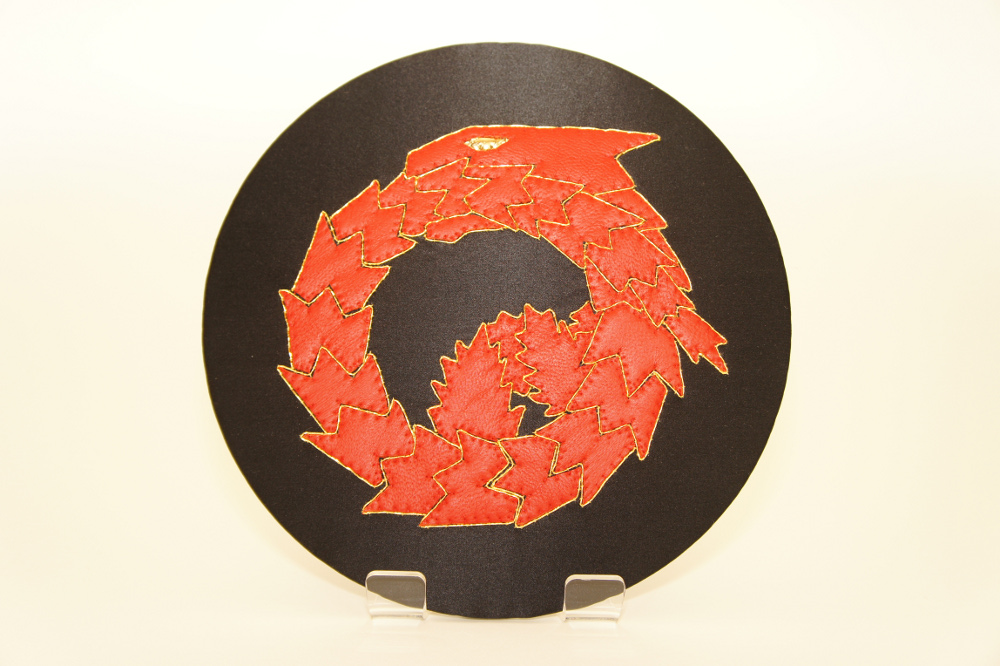
Over the steps leading into the shrine is something that might look familiar!


Another piece by the Broderers is a pulpit fall in the choir, with motifs based on designs from the Lindisfarne Gospels:


The High Altar and the other altars in the main body of the Cathedral just had plain covers at the time rather than embroidered frontals, so nothing much to see there, though there were some other interesting pieces.  None of these were made by the Broderers, however, so I'm afraid I don't have any information on them at all.

There was a rather nice processional banner for the Mothers' Union:


A hanging banner evidently commemorating a connection between Durham and Lesotho, in southern Africa:


And a large processional banner, but this time entirely secular in origin:


There was a long and proud coal mining tradition in North East England, and the annual Durham Miners Gala was a huge event in its heyday, with banners from each colliery paraded through the city.

Finally, into the Galilee Chapel, and a kneeler designed by Joan Freemen by the tomb of the Venerable Bede, also based on the Lindisfarne Gospels:


And an old and beautiful altar frontal in silk:


I don't have any information on this at all, I'm afraid, but it's just stunning.

If you're ever in the North East of England I can heartily recommend a visit to Durham Cathedral - it's well worth it.

Sunday, 30 September 2012

White Horse: completed

I said last time that there wasn't much left to do, and I've done it!

Firstly, I needed to finish the embroidery itself, with the final back leg:


It doesn't show up too well in the photo, but the stitching follows the shape of the horse's back end and curves round through 90 degrees, so that the stitch direction is downwards for the rest of the leg:


And that's all the stitching done!

There was still more to do to finish the piece, however, with pinning and damp stretching first:


(this photo shows the real colours better than any of the others, for some reason, so I'm glad you've finally got to see something close to what it really looks like).

The finished item was always intended to be a disc; cutting a neat circle of card is beyond me, I'm afraid, so I used a ready-made one: a cake board!  I stuck a circle of felt to this, both to soften it a bit and to hide the shiny silver foil it came covered with:


I trimmed and laced the back:


Then covered the lacing with darker green silk dupion, also backed with felt:


And here's the final piece: White Horse


I've already handed this over to the client (I wanted her to see it first, before writing this post, which is why there's been a slight delay), and I'm happy to say that she's pleased with it.  I hope she can enjoy it for many years to come!

Wednesday, 26 September 2012

New Etsy shop!

I've finally done something I've been meaning to do for ages, and set up a shop on Etsy.

And here it is: Ruth O'Leary Textile Art

I must admit that the initial stock is a bit random; I've had a major tidy out of trial pieces, items made for exhibitions and the like, and have listed them for sale.  They cover a range of techniques, from free machine embroidery:


Appliquéd leather:


Goldwork:


Split stitch landscapes:


And even smocking:


I intend adding to it as I go along, but in the mean time, have a look around!

Saturday, 22 September 2012

White Horse: half a horse

Time to fill in the horse's body, or at least half of it. Starting with the head and legs:


The stitching follows the shape of the horse, to help give it shape.

The face looks a bit odd like that, but looks better with the neck filled in:


And then the front leg:


And the main body:


Not much left to do now.

Tuesday, 18 September 2012

White Horse: finishing the knot and starting the horse

Some good progress to show you today, so without further ado, here's the knot finished:


And with the knot done, it's time to start the horse. The horse itself will be white, of course, but there's a little bit of colour for the hooves and eyes:


I'm still using Madeira stranded cotton, with no. 2114 (a dark brown) for the eye and 2208 (a gold) for the hooves.  I've also done the mane here, in 2403.  I'm going to use three shades on the body, and that's the one in the middle.

I'm not aiming for a particularly naturalistic effect here, but I still want a little bit of shading to give depth.  As the outline is gold metallic, I chose an ecru, 2404, as the darkest shade and added a line of that on the horse's underside, at the top of the rear legs, and under the chin:


I then used one strand of that and one of 2403 for the next line:


Two of 2403:


And then a line with one strand of 2403 and one of 2402:


This - 2402 - is the final colour.  The rest of the horse will be done using that.